
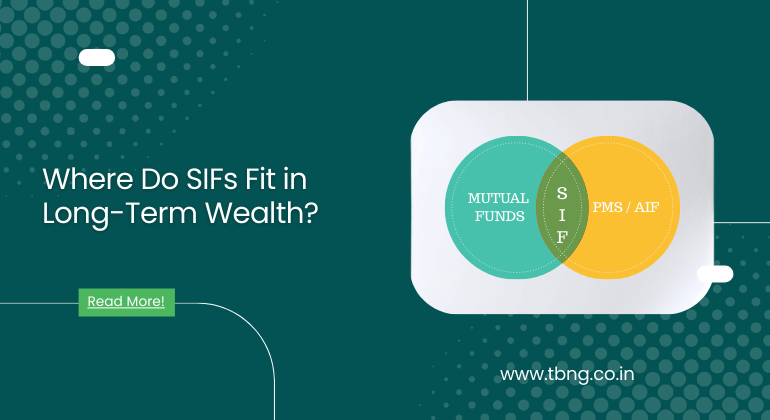
Every phase of the market gives rise to new investment structures that promise better control, smoother returns, or smarter outcomes. Specialised Investment Funds (SIFs) are part of this natural evolution in India’s regulated investing landscape. They introduce greater flexibility in how portfolios are managed, including the ability to use derivatives and, where the mandate permits, limited long–short strategies.
But for investors, especially high-net-worth individuals, the real question is not whether SIFs are innovative. The real question is where they fit within a long-term wealth journey that spans decades, not just market cycles. Because in the end, wealth is not built by strategy alone. It is shaped by behaviour, discipline, and the ability to stay invested during uncertainty.
What Makes SIFs Structurally Different
At a basic level, SIFs differ from traditional mutual funds in three important ways:
- They can use derivatives more actively for hedging, risk management, or income strategies, subject to the specific scheme mandate.
- They are allowed limited non-hedge short exposure (up to 25%), within SEBI-defined risk and exposure limits.
- They require a higher minimum investment of ₹10 lakh per investor per AMC
These features make SIFs more flexible than conventional funds. They allow portfolio managers to shape how returns behave, not just how much return is targeted. What they do not change is the underlying reality that markets will remain unpredictable, and all market-linked investments carry risk.
Why HNIs Are Paying More Attention to SIFs
The growing interest in SIFs is not accidental. It is rooted in changes investors have experienced over the past few years. First, volatility has become more frequent and sharper. Investors have seen markets fall quickly and recover just as fast. This has increased the demand for strategies that aim to reduce emotional stress during downturns, without eliminating market risk. Second, HNI balance sheets today are far more interconnected; business income, real estate, global investments, private equity, and market portfolios all influence one another. In such an environment, investors often look for tools that can stabilise the liquid portion of their wealth during periods of stress, because even a single allocation that behaves predictably can improve decision-making and indirectly support the overall portfolio. Third, behavioural fatigue is real. Even seasoned investors find it difficult to stay calm during sharp drawdowns. The desire for smoother portfolio movement is not just financial; it is deeply psychological because in periods of real stress, investors don’t abandon markets, they abandon plans.
The Behavioural Finance Lens: Why “Smoother” Feels Safer
From a behavioural standpoint, investors don’t struggle with returns as much as they struggle with uncertainty and regret. Losses feel almost twice as painful as gains feel pleasurable. This leads to panic selling during market falls, delayed re-entry after recoveries, frequent strategy switching and more often than not, chasing what worked recently.
Structures like SIFs have appeal because certain strategies aim to soften portfolio extremes, not eliminate risk, but make it emotionally easier to stay invested. When used wisely, this can protect investors from their own worst behavioural impulses. But there is a caveat here as well; when volatility reduces, complacency increases. And complacency often leads to:
- Larger-than-planned allocations
- Reduced respect for downside risk
- Overconfidence in structured strategies
Behavioural safety can quietly transform into behavioural blindness if not managed carefully.
The Risk of Expectation Mismatch
One of the most common behavioural mistakes investors make is expecting one tool to deliver multiple conflicting outcomes: They want equity-like growth, debt-like stability, zero drawdowns and predictable returns. No investment structure can deliver all four simultaneously. Every market phase tempts investors to forget this. If SIFs are viewed only as return enhancers, disappointment becomes inevitable, disappointment becomes inevitable. When that occurs, investors would want to give up on the strategy, usually at the wrong time.
The Bigger Shift That Truly Matters
The real importance of SIFs is not the strategy itself. It is the shift in how investors are beginning to think: from “How much can I make?” to “How smoothly can my wealth behave across uncertain markets?” That shift reflects a maturing approach to wealth, where emotional stability, decision quality, and long-term discipline are valued as much as performance. And that is ultimately what protects wealth across generations.
Closing Thought
Specialised Investment Funds are neither a breakthrough to be celebrated blindly nor a risk to be dismissed outright. They are simply another instrument in the growing orchestra of modern, regulated portfolio structures. Used in the right proportion, for the right purpose, and with the right expectations, they can quietly improve the investing experience. Used emotionally, excessively, or without clarity, they can create a new kind of hidden fragility. In long-term wealth building, tools will keep changing. Human behaviour will not.
The portfolios that endure are rarely the most complex. They are the ones investors don’t abandon when it matters most.