

Most founders treat the business as the family’s wealth. The two have different jobs, and confusing them is the quiet risk inside many successful families.
Every successful business family runs two enterprises.
The first has a GST number, an auditor and a founder who knows its numbers to the last rupee. The second has no name and no books. It is the family itself: the parents’ care, the children’s education, a wedding three years out, a retirement nobody has put a date on.
The first enterprise gets the founder’s best hours and every rupee of surplus. The second runs on what the first leaves behind. For years, the arrangement holds; then comes a month when both need money at the same time.
Not a concentration problem. A job problem.
The standard advice to business owners is to diversify. Most founders hear it as a request to bet less on themselves, and they are right to resist. The business is usually the best investment they will ever make.
The more useful question is what each rupee has been hired to do. Seen that way, business capital and family capital are not two slices of one pie; they are two employees with opposite job descriptions.
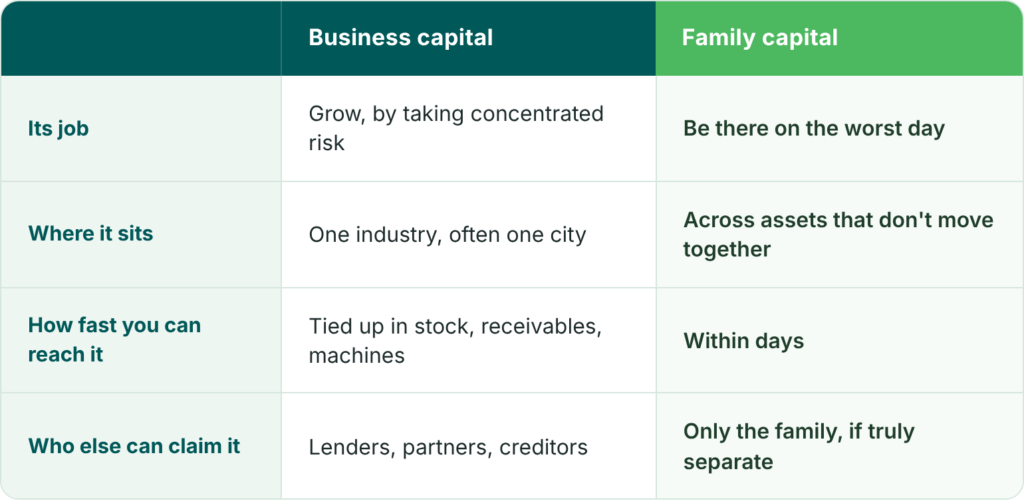
Business capital is built to take risk; family capital is built to absorb it. Asked to do both, one pool does neither well. Family capital has three jobs that the business capital cannot do for it:
● Stay liquid when the business needs cash
● Stay out of reach when the business has creditors
● Outlast the founder
What the mismatch looks like
Consider an illustrative family: a third-generation textile wholesaler, profitable for decades, worth about ₹45 crore on paper. Most of that is the business, its stock and the premises it runs from. The family home is pledged against the same bank limit as the godown. The money that is truly the family’s, free of the business and the bank, comes to about ₹2 crore. By most standards, that feels like a comfortable cushion.
Then, one season, a large buyer holds back ₹4 crore of payments. Suppliers still need to be paid and the bank asks for more security. The founder does what founders do: the family’s ₹2 crore goes into the business to hold the line, and it still isn’t enough. In the same quarter, the daughter’s overseas admission fee of around ₹70 lakh falls due. A family worth ₹45 crore on paper now has to ask its bank for money it has already earned.
The business itself is sound; one good year will set it right. But notice who moved the family’s money. Not the bank. The founder did, out of the same loyalty that built the business. Had a share of each year’s profit gone by rule into a pool the business was never allowed to draw on, the fee would have been a withdrawal. Instead, it became a negotiation.
Separation, then, is not only about protecting the family from the bank. It is about protecting the family from the founder’s own love for the business.
Job one: stay liquid
Family needs arrive on their own timetable: a fee, a wedding, a medical emergency. The business, meanwhile, needs the most cash in its worst months. Over enough years, the two are bound to collide.
The discipline is to pay the family like a shareholder, not a dependent. Decide before the year begins what share of profit leaves the business: a fixed draw, plus an annual sweep into the family’s own pool. A sweep that waits until expansion is funded rarely happens. Within that pool, keep a reserve that covers, say, two to three years of living costs and can be reached within days.
Job two: stay out of reach
A family home pledged for a working-capital limit is no longer only a home. Since 2021, successive Supreme Court rulings have confirmed that lenders can pursue a promoter’s personal guarantee under insolvency law, and that a company’s own resolution does not release the promoter from it. One signature can quietly tie every asset in your name to the business’s debts.
The discipline is to draw the legal line on purpose. Know every guarantee you have signed and what each can reach. Keep the family home out of business borrowing wherever possible. Ask your legal and tax advisers which ownership structures suit your family.
Job three: outlast the founder
This is the job most founders never assign, because they assume the business itself is the inheritance. Increasingly, it isn’t.
The son builds a career in Bengaluru; the daughter settles in London. Neither wants to run a wholesale business in their home town. When the business is the family’s only wealth, the next generation inherits an obligation: run it, sell it under pressure, or quarrel over it. When a separate pool exists, they inherit choices.
That is the difference between a family business and family wealth. The business can pass to whoever is best placed to run it. The wealth passes to everyone, on terms settled in advance: in wills, in nominations, and in a clear family understanding of who decides what. Fortunes that dissolve by the third generation rarely run out of money first. They run out of structure.
The number that matters
Turnover tells a founder how the business is doing. It says nothing about how secure the family is. The better measure is simpler and harder to face: if the business stopped tomorrow, how many years could the family live on what sits outside it?
Few founders know their answer. Fewer have a plan to grow it every year, independent of the business. Working out that number, and growing it, is the work of a family CFO: someone whose only job is the family’s balance sheet, not the business’s.